
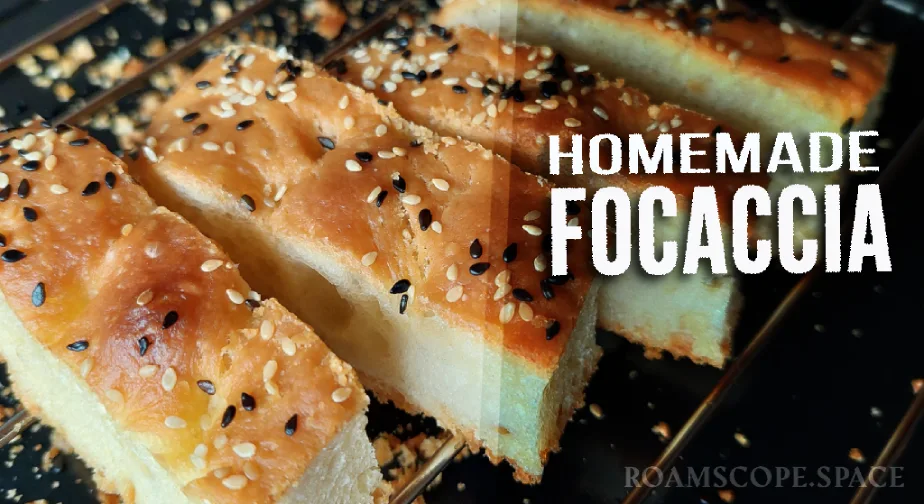
In one of my articles about Italy, I mentioned focaccia, and it kept me thinking: I wanted to bake this bread myself to understand the secret behind its popularity. Now, having tried it at home with a cup of strong, rich coffee, I understand—it is an ideal combination.
Ingredients
- Wheat flour: 1 kg (must be sifted—this makes the dough airy).
- Water: 650–700 ml (warm).
- Dry yeast: 10–12 g. (2 teaspoons).
- Olive oil: 6 tablespoons added directly during the kneading process. I set aside a little extra to grease the baking tray and the finished focaccia.
- Salt: 15–20 g. (2,5 teaspoons)
- Sesame seeds: for topping.
How I Prepare It
- Kneading: I sift the flour, add the yeast, salt, water, and 6 tablespoons of olive oil. The dough should be viscous and elastic. It shouldn’t be “clogged” with flour, but rather resemble a soft, pliable mass that slightly sticks to the hands while still holding its shape.
- Fermentation: The dough should proof in a warm place for 1.5 to 2 hours. It should at least double in volume.
- Preparing the Tray: I use only a tray with high sides. This is crucial: if the sides are low, the dough might simply “escape” while rising in the oven.
- Shaping: I grease the tray with oil, place the dough in, and gently stretch it by hand. The optimal thickness of the dough layer should be about 2–3 centimeters. If it’s too thin, it will turn into a cracker; if too thick, it might not bake through in the center. I use my fingers to make deep dimples all over the surface—this is a classic technique that helps the dough absorb the oil better.
- Sesame and Crust: To get a golden, ruddy crust, I lightly drizzle the top of the focaccia with olive oil before putting it in the oven. I add the sesame seeds immediately after dimpling the dough: I press them slightly into the surface so they don’t fall off and bake directly into the crust—this significantly improves the taste.
- Baking: I put it into a preheated oven. Standard baking time for focaccia is usually about 20–30 minutes at 200–220°C. However, it is important to adjust for my specific oven: my “Hefest” stove requires its own approach. Last time, the focaccia turned out very tasty with a crispy crust in 55 minutes without burning. But to preserve even more softness in the crumb, next time I plan to reduce the time to 45 minutes. This will be my experiment to find the perfect balance.
- Final Steps: I take the focaccia out, let it “rest” in the tray for a couple of minutes, and immediately transfer it to a wire rack. If left in the hot tray, the bottom will get damp from condensation, and the crispiness will disappear.
Visual Readiness Check: Baking Without Skewers
Many are accustomed to checking readiness with a wooden skewer, but for focaccia, this is not the best method. Opening the oven causes a sharp drop in temperature and pressure, which disrupts the pore structure. Professionals prefer visual control through the oven glass.
How to determine readiness:
- Golden Color: The primary indicator is an evenly golden crust. As soon as the top turns a rich golden color, it is a signal to finish.
- Bubbles: During baking, the focaccia surface “breathes.” When the small bubbles on the surface stop forming actively and become “set,” it indicates that the interior crumb structure has stabilized.
- Texture Balance: My experience shows that reducing the time from 55 to 42 minutes drastically changes the result. At 42 minutes, the crust remains crispy, yet it is much softer than with a longer bake. If you bake it for 55 minutes, the top and bottom crusts become twice as thick and significantly harder. Since nothing burns even at 55 minutes, I recommend aiming for 40–45 minutes, focusing on the visual state of the crust.
Main Conclusion
Don’t blindly trust online instructions. Keep track of your results: how much time it took, what the thickness of the dough layer was, and how exactly your specific oven behaves. Baking is a process of fine-tuning, where every nuance matters.
Support
If you enjoyed this article, please share the link on social media and support my development with a donation.