
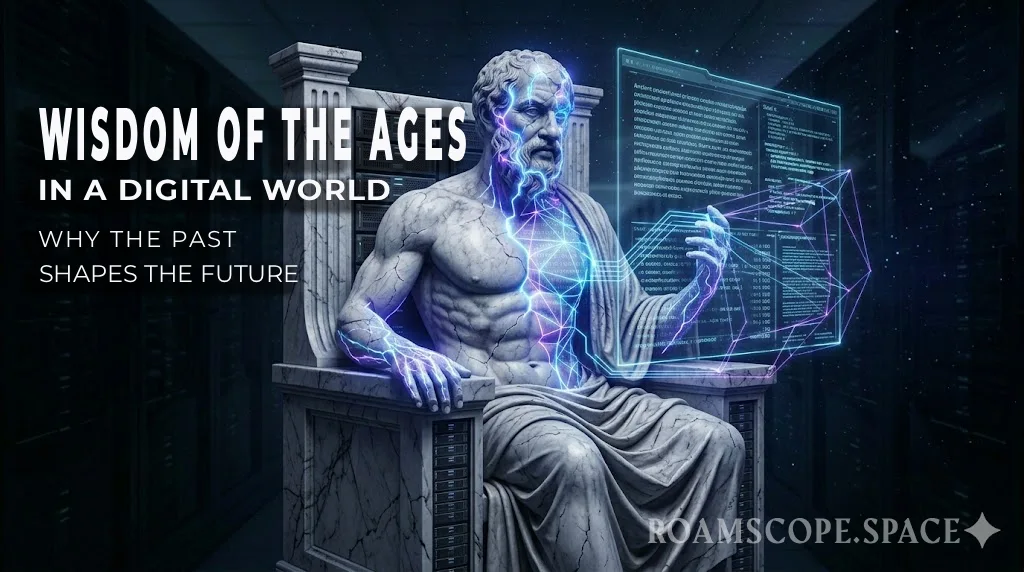
There is a striking paradox in the way we, the people of the era of artificial intelligence and interplanetary ambitions, continue to look back into the dust of ancient roads and the twilight of medieval cells. It would seem: what does a software developer, a drone designer, or a network security specialist have to do with the thoughts of people who never even saw electricity? However, the deeper we dive into the technological thickets, the more clearly we realize: our “tomorrow” is merely a superstructure built upon a powerful, unshakable “yesterday.” We are dwarfs standing on the shoulders of giants, and it is precisely this position that allows us to see just a little bit further beyond the horizon.
Surprisingly, the basic principles of logic that operate a modern computer were formulated long before the appearance of the first transistor. Aristotle, who systematized the laws of thought in the 4th century BC, essentially laid the foundation for every if-else condition in your code. When we build an algorithm, we are not reinventing the wheel — we are walking in a groove cut by ancient thinkers. Why does their word remain alive to this day? The answer lies in the immutability of human nature. Over thousands of years, our tools have changed beyond recognition: from wax tablets to cloud storage, from a messenger on horseback to a fiber-optic cable. But the fundamental questions remain the same: how to distinguish truth from falsehood, how to build a resilient system, and how to maintain clarity of mind amidst the chaos of change.
When I face difficulties — whether it is mastering the syntax of a new programming language, a physical injury, or configuring a complex home network — I instinctively turn to the Stoics. Marcus Aurelius or Epictetus taught us to divide things into those that are under our control and those that are outside of it. In the world of IT, this sounds more relevant than ever. We cannot control the bugs in third-party libraries or sudden changes in search engine algorithms, but we fully control our reaction to these events and the quality of our own code. This continuity of wisdom creates a bridge across centuries, turning ancient texts into practical manuals for survival in the digital jungle.
Modern humanity often suffers from an illusion of exceptionalism. It seems to us that our problems are unique and our knowledge is absolute. But one only needs to open Plato to discover a discussion on the nature of reality that is hauntingly reminiscent of modern debates about simulation and virtual worlds. We rely on ancient scholars because they possessed a luxury that we are deprived of — the time for pure contemplation and analysis without the noise of endless notifications. Their thoughts are a purified concentrate of experience, stripped of the deposits of fleeting fashion. In mathematics, philosophy, and even the art of leadership, the foundations remain unshakable. The word of our ancestors lives because it resonates with the very architecture of human consciousness. We use their wisdom not as an archival reference, but as a compass that does not falter during the magnetic storms of technological progress.
The connection of times is not just a beautiful metaphor; it is a mechanical necessity. Without the foundation of the past, modern science would turn into a house of cards, devoid of logical support. Every time we write a script to automate a blog or design a complex mechanism, we lead a silent dialogue with those who first pondered the harmony of numbers and the logic of systems. This realization provides incredible strength: you are not alone in the face of a difficult task; thousands of years of accumulated human genius stand behind you. And perhaps, hundreds of years from now, someone else, setting up a connection between stellar systems, will likewise open our records from today and find in them a foothold for their own achievements. The wisdom of the ages is the only resource that is not exhausted by use, but only multiplied, binding us into a single chain of the endless search for truth.
If these reflections have resonated with your soul or helped you look at familiar things differently, you may share the link to this article with your friends. For those who wish to support the author in the development of projects and the blog, an option for voluntary donations is available. Your attention and support are what provide the strength to continue this dialogue across the centuries.