
Overcoming Procrastination: How Micro-Actions Pave Your Path to Progress
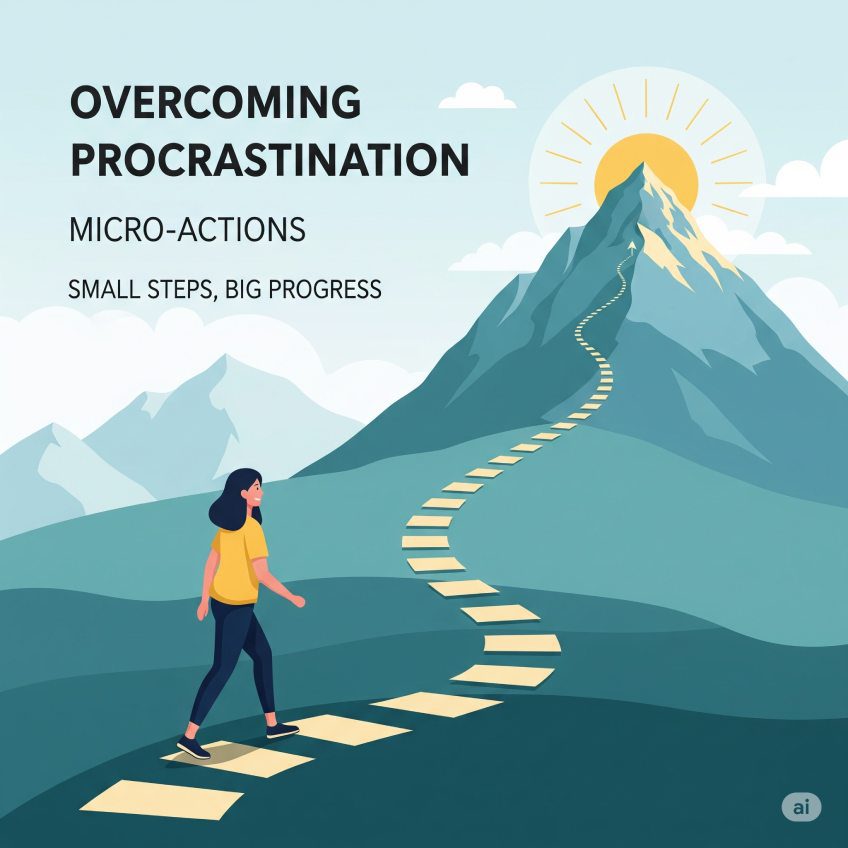
Constantly putting things off despite the consequences? Discover what pathological procrastination is and how micro-actions can help you step by step reclaim your productive life.
My Journey: Living with Procrastination and Finding a Way Out
I know firsthand what pathological procrastination feels like. This state has been with me since my school days, transforming ordinary tasks into insurmountable barriers. Finding effective methods to combat it hasn’t just been an academic interest; it’s been a vital necessity in my life.
In the process of this search, I discovered that many common approaches miss a crucial detail. The impact of stressful situations — which, let’s be honest, can derail anyone — not only amplifies existing procrastination but also makes it incredibly difficult to focus on anything at all. It’s in these moments, when stress levels are through the roof, that the grip of procrastination feels strongest.
Yet, it’s precisely in these times, when all hope seems lost, that micro-actions have become my lifeline. They help, slowly but surely, to break free from inertia and gradually accomplish what I set out to do. Whether it’s washing the car, tidying up a room, mowing the lawn, or simply going to the grocery store – each tiny step becomes a victory.
Everything I share in this blog is rooted in my personal journey to overcome my own “demons” and improve my well-being. Perhaps it sounds self-centered, but it’s this very personal experience that allows me to share genuine and tested strategies. I truly believe my content can help others struggling with similar issues, improve their quality of life, or perhaps even help them just start living to their fullest potential. My articles aren’t merely blog content or an attempt to attract readers; they are, first and foremost, written for myself.
But enough about that tangent. Let’s get back to our core topic: pathological procrastination and the micro-actions that can slowly but steadily help you break free from its grasp.
What is Pathological Procrastination?
Imagine this: You know perfectly well you need to do something – perhaps write an important report, clean your apartment, or go to the doctor. But instead of tackling the task, you find yourself doing something entirely different: endlessly scrolling through social media, watching videos, or simply pacing around the room. This goes on day after day, week after week.
Pathological procrastination is far more than just laziness. It’s a chronic, recurring habit of delaying important tasks, despite knowing the negative consequences that will follow. The individual experiences significant stress, guilt, anxiety, and even self-loathing. They genuinely want to complete the task but simply cannot initiate it, as if an invisible wall prevents them from taking the first step.
Key indicators of pathological procrastination:
- Chronic nature: This isn’t a one-off delay, but a consistent, ingrained pattern of behavior.
- Significant distress: The procrastinator experiences considerable discomfort due to unfulfilled obligations.
- Negative consequences: This behavior leads to problems at work, in studies, in personal life, and can even negatively impact health.
- Self-deception: The person often makes excuses for not starting a task (e.g., “I’ll do it tomorrow when I’m in a better mood”).
- Emotional ties: It’s frequently linked to fear of failure, perfectionism, anxiety, and low self-esteem.
Why Does It Happen?
Often, at the heart of procrastination lies not a simple unwillingness, but a deep psychological discomfort associated with the task itself. This can be triggered by:
- Fear of failure: “What if I mess it up?”
- Perfectionism: “If I can’t do it perfectly, why bother starting?”
- Fear of success: (less obvious, but real) “What if I succeed, and then even more responsibility is placed on me?”
- Lack of clarity: “I don’t know where to begin; the task feels too overwhelming.”
- Low self-discipline: Simply not having the habit of taking immediate action.
What Are Micro-Actions and How Do They Help?
A micro-action is an incredibly small, elementary step that requires minimal time and effort. It is the first, tiny move towards completing a larger task.
The whole idea is to break down that “invisible wall” that prevents us from starting. When a task feels enormous and intimidating, our brain resists. But if the task is so minuscule that it doesn’t trigger internal protest, the brain often agrees: “Alright, I can definitely do that!”
How it works:
- Reduces resistance: The brain sees a tiny pebble it can easily move, not a giant mountain to climb.
- Builds momentum: By starting with a micro-action, you create initial forward momentum. Often, after taking the first step, it becomes much easier to take the second, then the third, and so on. You get the ball rolling.
- Lowers anxiety: If a task feels overwhelming, anxiety can be paralyzing. A micro-action is so small it doesn’t trigger significant anxiety.
- Creates a sense of accomplishment: Even completing the tiniest action brings a small sense of satisfaction and success, which serves as a powerful motivator for subsequent steps.
Examples of Micro-Actions to Overcome Procrastination:
- Task: Write a thesis/report
- Micro-action: Open the document file.
- Micro-action: Type the title.
- Micro-action: Find one article online related to the topic.
- Micro-action: Read the first paragraph of one article.
- Micro-action: Write just one sentence.
- Task: Clean your room
- Micro-action: Pick up one item from the floor and put it away.
- Micro-action: Take one mug out of the room to the kitchen.
- Micro-action: Throw away one piece of trash.
- Micro-action: Straighten one pillow on the couch.
- Task: Work out
- Micro-action: Put on your workout clothes.
- Micro-action: Walk to the gym door.
- Micro-action: Do just one squat.
- Micro-action: Simply walk into the gym.
- Task: Make an important phone call
- Micro-action: Open your contact list.
- Micro-action: Dial the first three digits of the number.
- Micro-action: Just pick up the phone.
- Task: Leave the house (if struggling)
- Micro-action: Put on your shoes.
- Micro-action: Open the front door.
- Micro-action: Look out the window.
How to Apply Micro-Actions in Practice:
- Identify the main task you’re procrastinating on.
- Break it down into the smallest, most elementary steps possible. Remember, not “make the call,” but “pick up the phone.” Not “write the report,” but “open the file.”
- Choose the very first, easiest micro-action.
- Execute only that micro-action. Don’t think about the next step; just focus on completing the current one.
- Repeat. If after the first micro-action you feel a surge of energy and momentum, proceed to the next one. If not, that’s perfectly fine. Try another micro-action tomorrow, or even in an hour.
The most crucial thing is not to pressure yourself or demand immediate completion of the entire task. The goal of micro-actions is to start, not to finish. And often, this tiny first step turns out to be the most challenging yet most effective one in overcoming pathological procrastination.
Support the Author and Help Others!
If this article resonated with you and proved helpful, I would be genuinely grateful if you could share a link to it on your social media and messaging apps. Perhaps someone you know is also struggling with procrastination and might find support and practical advice within these lines. Together, we can help more people start taking action.
Support the Project’s Growth
Creating content like this, based on personal experience and a deep dive into the subject, requires time and resources. If you feel that my materials bring you value and help you manage the “demons” of procrastination, you can support the project’s development with any amount you feel comfortable contributing. Your support will allow me to continue sharing valuable insights and experiences, creating new articles, and helping even more people gain control over their lives.
Thank you for your attention and support!



 Support our blog! Buy us a coffee, and we'll show you the world! ☕🌍 We need your help! Even a small amount will help us continue to delight you with interesting travel articles. Thank you for your support! 💖