
OMAD: One Meal a Day. Science, Sadhguru’s Wisdom, and Dr. Berg’s Protocol
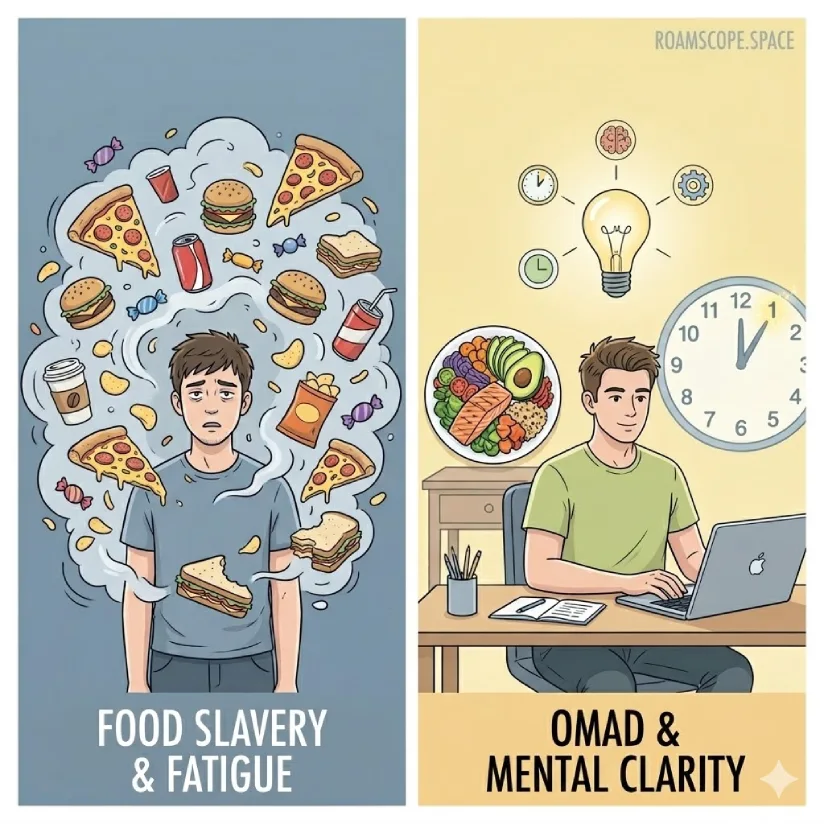
In a world where food is available 24/7, the idea of eating only once a day might sound extreme. However, the OMAD (One Meal A Day) strategy isn’t just a trend—it’s a return to our biological roots. Today, this ancient practice is being validated by both modern science and time-tested spiritual traditions.
What is OMAD and How Does It Work?
At its core, OMAD is the most advanced form of intermittent fasting, typically following a 23:1 protocol. You fast for 23 hours and consume your daily nutrients within a one-hour window. Physically, this triggers a powerful process called autophagy.
Nobel Prize winner Yoshinori Ohsumi proved that when cells go without food for extended periods, they begin to recycle their own “waste”—damaged proteins and old cellular components. Your body essentially performs a deep spring cleaning. With frequent snacking, this vital process simply never has the chance to start.
The Western Perspective: Dr. Berg and Insulin Biochemistry
Dr. Eric Berg, a leading expert on Healthy Keto, views OMAD as the ultimate tool for managing insulin. Every time we eat, insulin—the primary hormone responsible for fat storage and aging—spikes. Constant snacking keeps insulin levels chronically high.
OMAD allows insulin to drop to its baseline for the maximum amount of time. This doesn’t just accelerate fat burning; it gives your pancreas a much-needed break, sharpens cognitive function, and significantly reduces systemic inflammation.
The Eastern Perspective: Sadhguru and Mindfulness
Indian yogi and mystic Sadhguru approaches this from the perspective of energy management. He suggests that for anyone over the age of 30 who isn’t performing intense manual labor, one meal a day is often the ideal state. In the yogic tradition, allowing at least an 8-hour gap between meals allows the body to heal itself.
Sadhguru emphasizes that the body shouldn’t be constantly bogged down by digestion. When the digestive system is at rest, that energy is redirected toward the brain and heightened awareness. The mind becomes sharp, and the body feels remarkably light.
Personal Experience: Balance and Flexibility
I often share my personal journey here, and OMAD has become a cornerstone of my routine. However, I believe in flexibility rather than rigid dogma. I practice OMAD but often alternate it with a 2-meal intermittent fasting schedule, following Dr. Berg’s principles.
The secret lies in balance. If your single meal is nutrient-dense, packed with healthy fats, and high-quality proteins, you will have more than enough energy for the day. My experience confirms it: “food slavery” disappears. You no longer think about your next meal every three hours. Post-lunch brain fog is gone, replaced by steady focus and productivity that lasts until evening.
What Does Science Say?
Studies published in journals like Cell Metabolism confirm that Time-Restricted Feeding (TRF) can:
- Improve gut microbiome health.
- Increase cellular stress resistance.
- Stimulate the production of BDNF (Brain-Derived Neurotrophic Factor), which helps grow new neurons and improves memory.
However, scientists warn that for some—specifically those with gallbladder issues or adrenal fatigue—the transition to OMAD must be gradual and carefully managed.
A Lifetime Practice: Is It Sustainable?
There are countless examples of people living on OMAD for decades, from Buddhist monks to Silicon Valley high-performers. For many, it becomes a natural lifestyle because the alternative—feeling “perpetually full and sluggish”—is no longer appealing.
DISCLAIMER: This article is for informational purposes only and describes the author’s personal experience. Transitioning to OMAD or making any radical dietary changes should only be done after consulting with a qualified healthcare professional. Self-experimentation without considering your unique health profile can lead to serious complications.
Conclusion
OMAD is a path toward freedom from the habit of constant grazing. it’s an opportunity to give your body a real chance to regenerate. When approached mindfully, supplemented with the right vitamins and quality whole foods, the results can be truly transformative.
On this blog, I document my progress in personal development, health, technology, and science. If you found this article helpful, please share the link on your social media.
If you wish to support my work and the growth of this blog, you can leave a donation. Any support on my journey is deeply appreciated!




 Support our blog! Buy us a coffee, and we'll show you the world! ☕🌍 We need your help! Even a small amount will help us continue to delight you with interesting travel articles. Thank you for your support! 💖