
Why the battles you avoid are your greatest victories
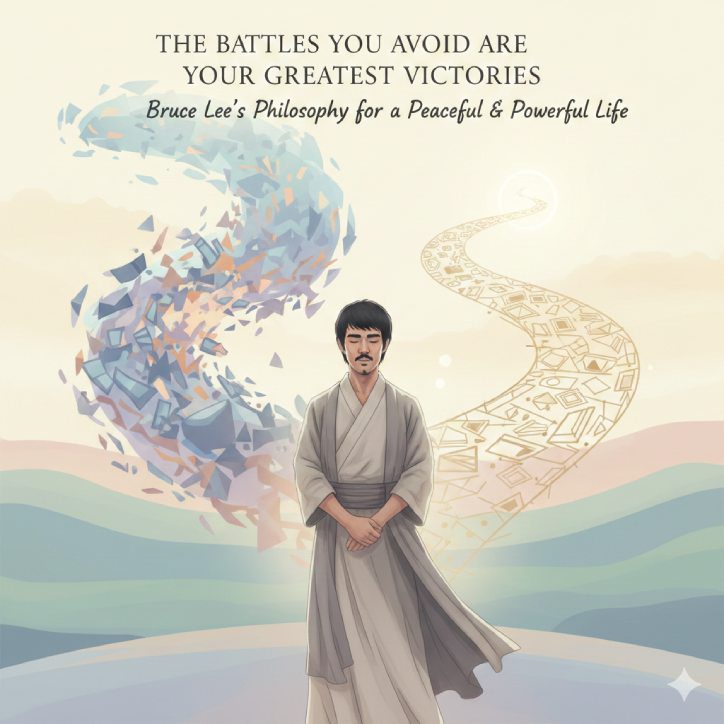
While watching the TV series Warrior, I came across a profound quote that forced me to hit pause and reflect deeply. This single thought provides a key to a wise, tactically, and strategically sound way of handling life’s challenges. It helps in shaping our actions and behavior when pursuing specific goals—whether it’s protecting your boundaries at work or maintaining inner peace amidst domestic chaos.
The quote is: “The battles you avoid are just as important as the battles you fight.”
This isn’t just a clever line of dialogue; the Warrior project is based on the personal writings of the legendary Bruce Lee—notes that waited decades to be brought to life. The Master understood what modern psychology and NLP (Neuro-Linguistic Programming) confirm today: our attention is a finite resource. Anyone who forces you to react emotionally is effectively hacking your brain. When you engage in a forced argument, you hand over the remote control of your nervous system to your opponent. Here, it is vital to understand a psychological concept called rapport (pronounced ra-PORE). In psychology, it signifies a deep connection or bond. Do not confuse it with a “report.” Provocators often establish a specific kind of rapport, tuning into your frequency just to find your pain points and manipulate your behavior.
In any environment, you may encounter provocators who practice bullying. From an NLP perspective, they seek rapport through conflict, trying to trigger a predictable reaction: anger, justification, or fear. If a person begins to emotionally explain why they are right or how hard they work, they subconsciously adopt the position of a victim. They feed the aggressor with their energy, and the more they “fight” with words, the more the bullies want to “peck” at them, seeing that their actions are hitting the mark. In such a situation, an excuse is a signal of victory for the attacker.
Common sense and strategy suggest the opposite: sometimes the most devastating blow is the one you never throw.
When a provocation is sincerely ignored, it creates a “vacuum.” In psychology, this is known as a pattern interrupt. The aggressor expects an explosion; they are ready for it, but instead, they hit a wall of icy calm and silence. In that moment, it is not the target who suffers defeat, but the provocator who loses power. You literally switch the opponent out of your reality, saving your strength for the battles that truly lead to your goals.
However, Bruce Lee’s strategy does not call for being a helpless victim. It teaches mindfulness: the ability to clearly distinguish between empty “noise” and a real “threat.” If attacks cross the line into a violation of your rights—when supervisors begin to openly lie or falsify facts—silence becomes a mistake. But even here, a warrior does not stoop to shouting. Instead of an emotional battle, you switch to “Cold Record” mode. Simply turn on a voice recorder in your pocket and begin, in a calm, dry voice, to ask for details of every accusation.
Many fear that covert recording is illegal, but I believe this is a misconception in the context of self-protection. From the perspective of international law and human rights, covert audio recording is recognized as a legitimate and necessary form of self-defense. If your rights are being violated—be it through bullying, extortion, or professional fraud—and there is no way to record it openly, such a recording serves as the only way to provide evidence. You are not recording “trade secrets”; you are recording an illegal act committed against you. International norms place the right to judicial protection and personal integrity above any corporate instructions.
Insight comes when you realize: calmness is not a weakness; it is the ultimate form of dominance. The person who remains silent and records facts is always more dangerous than the one who screams and makes excuses. When you stop proving your worth to those who refuse to see it, you become invulnerable and extremely “inconvenient” for manipulators.
Victory comes the moment you make a conscious decision: “This battle will not make me stronger, therefore I will not enter it.”
Be like water—flow around their anger, record their foolishness, but never let it inside your mind.
Disclaimer: I am not a professional lawyer or psychologist. These reflections are based on common sense and an analysis of open legal concepts. In complex situations, it is always necessary to seek qualified legal counsel.
If this article helped you find a foothold or look at your current problems in a new way, I invite you to share the link with those who are also struggling right now. Support and donations for the project’s development allow me to create such materials more often and help people find clarity of mind.



 Support our blog! Buy us a coffee, and we'll show you the world! ☕🌍 We need your help! Even a small amount will help us continue to delight you with interesting travel articles. Thank you for your support! 💖