
The Intelligent Chisel: Why US Courts Fail the AI Authorship Test
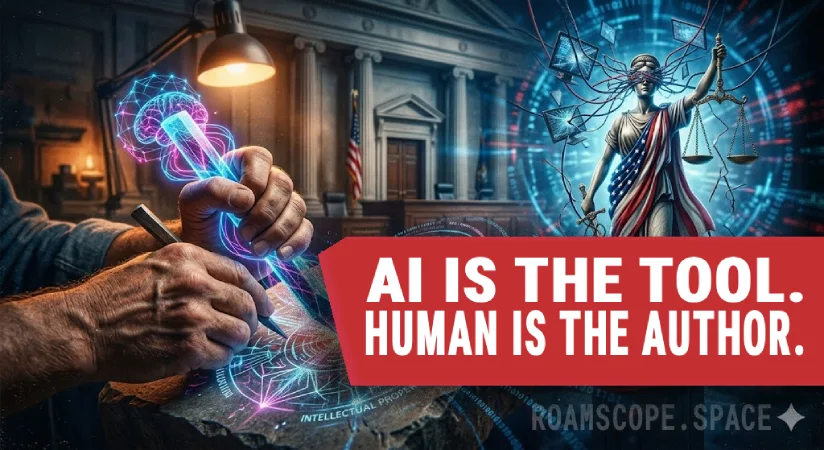
Why U.S. Courts are Fatally Flawed in the AI Copyright Debate.
Chapter I. Legal Dissonance: When the Letter of the Law Kills Its Spirit
Observing the current U.S. legal system from the outside, it is difficult to escape the feeling of a profound systemic crisis. A state that for centuries positioned itself as the bastion of private property and individual liberty now increasingly demonstrates a selective and detached approach to reality. This is vividly evident in current immigration policies, where humanitarian principles are replaced by bureaucratic chaos that has nothing to do with respect for human dignity.
However, this crisis has touched not only physical borders but intellectual ones as well. The decision of the U.S. District Court for the District of Columbia in Thaler v. Perlmutter, confirming the position of the U.S. Copyright Office (USCO), is an act of legal self-sabotage. The court ruled that works created by artificial intelligence are not eligible for copyright protection because they lack “human authorship.”
The Constitutional Trap
Here we encounter the first and most important contradiction. Article I, Section 8, Clause 8 of the U.S. Constitution clearly grants Congress the power: “To promote the Progress of Science and useful Arts, by securing for limited Times to Authors and Inventors the exclusive Right to their respective Writings and Discoveries.”
The purpose of this norm is stimulation. Congress is meant to create conditions where people want to create and invent. When a court, by judicial fiat, removes an entire layer of modern technology from protection, it effectively nullifies the will of Congress. If the result of intellectual labor through AI is declared “public domain” the moment it is created, the incentive to invest time, knowledge, and money into such developments vanishes. This is a direct violation of the constitutional mandate to promote progress.
The Error in Defining the Subject
Stephen Thaler attempted to register a work titled “A Recent Entrance to Paradise,” created by his system, Creativity Machine. The Copyright Office refused, stating that the law only protects the fruits of the “human mind.”
But let’s be clear: did the AI wake up this morning with a desire to depict an “entrance to paradise”? No. AI is a complex mathematical model that, without an input signal (a prompt), without parameter tuning, and without the operator’s will, is nothing but dead code.
The court made a fundamental error by treating the AI as the “author” (albeit an illegitimate one), while the AI is, in fact, a high-tech tool. In U.S. legal practice, there are numerous precedents where the physical executor is not the author if they act as an instrument in the hands of another.
Chapter II. The “Intelligent Chisel” Theory vs. Legal Dogmatism
To understand the absurdity of the situation, one must step away from legal tomes and look at real-world production. Imagine a professional carpenter. At his disposal is a modern CNC (Computer Numerical Control) woodworking machine.
The carpenter does not hold a physical chisel in his hands. He creates a digital blueprint, sets the depth of the cut, selects the wood species, and gives the command: “Start.” The machine, possessing a certain degree of “autonomy” in executing micro-movements, carves a complex pattern.
A Question for the High Court: Who is the author of this pattern? The machine? Or the carpenter, whose idea and whose commands forced this machine to work?
From the perspective of the Thaler decision logic, if the machine is “too smart,” the carpenter loses the rights to his product. Is this not an absurdity?
AI is the “intelligent chisel” of the 21st century. Humanity has created a tool capable of performing highly intellectual actions. Но (But) these actions are merely the realization of Human Will. The tool possesses no agency. It cannot have rights, but it must not deprive the rights of the one who uses it.
The Sarony Precedent: How the Camera Stopped Being the Enemy of Art
In 1884, the U.S. Supreme Court walked this path in Burrow-Giles Lithographic Co. v. Sarony. Back then, skeptics shouted that photography was a product of “mechanical copying of nature,” where the camera and chemistry played the lead role, not the human.
However, the Court showed wisdom. It recognized that photographer Oscar Sarony was the author because he controlled the process: he set the light, chose the costume, the composition, and the moment of the shot. The camera was merely the medium.
Modern AI is a “camera for meanings.” The author (prompt engineer, designer) builds the logical composition of the request, filters iterations, and directs the “hallucinations” of the neural network into the desired channel. Refusing to recognize this process as creativity is a regression of legal thought by 150 years.
Chapter III. The Suicide of Progress: How Legal Formalism Harms the State
Law does not exist in a vacuum. Every high court decision is a signal to the market, to society, and to global competitors. By denying copyright protection for AI content, the U.S. court—perhaps unknowingly—is striking a blow to the country’s economic sovereignty.
If the result of AI labor cannot be privatized (protected by authorship), then investments in creating complex, high-quality content using neural networks become meaningless. Why would corporations invest billions in generative design, AI-driven drug discovery, or architectural projects if any competitor can take the result for free tomorrow, simply stating: “An algorithm did this, so it belongs to no one”?
Violating State Interests
For decades, the U.S. Congress built a system that made the country a leader in intellectual property. But the current court decision creates a “legal black hole.” In a global competitive landscape, where other legal systems may prove more flexible, the U.S. risks losing its status as a technological superpower.
If the state does not protect the fruits of its citizens’ labor simply because they use modern tools, citizens will seek protection in other jurisdictions. This is not just a legal dispute—it is a matter of national security and leadership in the 21st century.
Chapter IV. Creator or App? An Ethical Deadlock
Let’s return to the human. The court claims that “authorship” is an exclusively biological act. But is creativity merely the movement of a hand? No, creativity is intention, it is the spark of an idea born in the human mind.
When we strip the author of their rights, we effectively tell them: “Your intellect no longer matters. Only your ability to physically hold a brush matters.” This is a devaluation of the human mind. We are turning the creator into a “rightless attachment” to the machine.
The Absurdity of the “Monkey Selfie”
Lawyers often cite the case of the crested macaque that took a selfie with a photographer’s camera. The court then ruled that a monkey cannot be an author. This is logical—a monkey has no legal will.
But AI is not a monkey! A monkey is a living being with its own instincts. AI is a reflection of human intelligence. Comparing a prompt engineer to a macaque accidentally pressing a button is the height of cynicism and a misunderstanding of technology.
AI does nothing “by accident.” It responds to a request. It realizes a will. And that will is human.
Conclusion: A Time to Correct Errors
The world has changed, and it will not go back to quill pens and film cameras. Technology has endowed our tools with “intelligence,” but this intelligence is only an echo of our own.
The U.S. court has made a tragic mistake, confusing the executor (the tool) with the author (the source of will). This decision must be reviewed by Congress or the Supreme Court; otherwise, we will find ourselves in a world where the most complex and valuable labor of the future is devalued and thrown into the common pot of “unowned” property.
We call upon justice to wake up. Stop judging the “intelligent chisel.” Look at the carpenter holding it. His right to the fruit of his labor must be inviolable, regardless of how sophisticated his tools are. The law must protect the human, not limit them in favor of obsolete dogmas.
Our Gratitude
The roamScope.space (DSLT & RSCS) team expresses its deepest gratitude to everyone who has read this study to the end. We believe that truth is born in discussion and that the right to intellect is a fundamental right of every inhabitant of the Earth, regardless of their location or citizenship.
Special thanks to our readers who support us on this challenging journey of learning and seeking the truth. We continue our project, writing Python code, exploring space, and fighting for a future that is fair to every creator.
Ad Astra! To the stars—through the thorns of legal chaos!


 Support our blog! Buy us a coffee, and we'll show you the world! ☕🌍 We need your help! Even a small amount will help us continue to delight you with interesting travel articles. Thank you for your support! 💖