
The Architecture of Inner Order: Combining Stoicism and Flow for Deep Learning
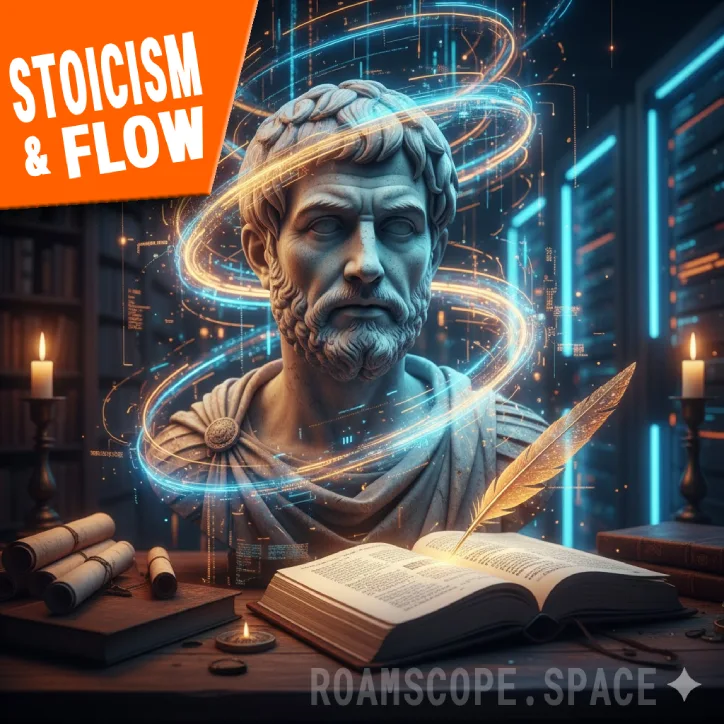
Emperor and Professor: How Marcus Aurelius and Csikszentmihalyi Can Help You Master Reality.
Like many of you, I am in constant search of practical, actionable methods for self-development. This became especially critical when I began learning to program. To be honest, it is incredibly challenging for me. It is a complex discipline that I am trying to master, often fighting the resistance of my own mind.
In this article, I will share one particular methodology—or rather, the practical steps—that has significantly eased my learning process. This is no magic pill; it might not work for everyone, but it has been a lifeline for me. I am sharing it in the hope that it will help you, my dear reader, as much as it has helped me. I will continue to explore new approaches and share my journey and findings with you along the way.
Attention: The Primary Currency of Life
We are often told that productivity is about time management or the latest apps. In reality, it is a battle for attention. In this battle, we have two great allies: the Roman Emperor Marcus Aurelius and the psychologist Mihaly Csikszentmihalyi, the father of “Flow” theory.
There is an 1800-year gap between them, yet they share a fundamental truth: the quality of your life depends on what your mind is focused on.
1. The Inner Citadel: The Stoic Filter
Csikszentmihalyi argues that happiness is “ordered consciousness.” When you are in a “Flow” state, your psychic energy is directed toward a single goal, leaving no room for chaos. Marcus Aurelius called this the “Inner Citadel.” He wrote: “Your life is what your thoughts make it.” If you do not control your attention, external noise—news, fears, or trivial problems—will control it for you.
How I apply this to coding: Before I open my code editor, I perform an “inventory” of my anxieties. If I am worried about daily life or the future, I tell myself: “This is outside my control at this moment.” I consciously close the gates of my Inner Citadel, leaving everything behind that does not pertain to the syntax or logic I am currently studying.
2. Balancing Complexity: Finding the “Sweet Spot”
Csikszentmihalyi’s key discovery is that flow only occurs when the challenge slightly exceeds your current skills.
- If the task is too easy, you get bored and distracted.
- If the task is too hard (as often happens with Python or C++), you experience anxiety and “stall.”
Practical Step: When I feel like I am hitting a wall, I don’t give up. Instead, I break the task down until it becomes “challengingly manageable.” This is the architecture of inner order—the ability to crush the granite of science into small stones that you can actually lift.
3. Obstacles as Fuel
Marcus Aurelius left us a brilliant formula: “The impediment to action advances action.” In programming, this is literal. Every console error is not a judgment on my intelligence, but a roadmap. If a task seems impossible, don’t view it as a wall; view it as an entry point into a deep Flow state. Flow is the moment when the “Self” disappears, and only the problem-solving process remains.
4. Deep Work and Silence
Csikszentmihalyi emphasized the importance of eliminating distractions. Today, this requires nearly imperial discipline. We cannot enter a Flow state if we check notifications every five minutes.
My Method: I create an “intellectual vacuum.” I unplug everything, hide my phone, and enter a state of deep focus. This is my personal asceticism. Marcus Aurelius wrote his Meditations in military tents amidst the noise of camp life. If he could find silence within himself under those conditions, we can surely disconnect from our messengers for an hour.
5. The Reflection Journal: Your Mind’s Logbook
Few people realize that Marcus Aurelius’s Meditations was originally titled “To Himself.” It was a private journal where the Emperor analyzed his actions.
Csikszentmihalyi confirms that for Flow to persist, you need feedback. In coding, the interpreter gives you feedback; in your learning journey, the Reflection Journal does.
How to keep this journal:
- Fixing “Stalling Points”: Record where you got stuck today and why. This moves the problem from the realm of emotion to the realm of concrete tasks.
- Evening Stoic Review: At the end of the day, ask: What did I do right? Where did I lose focus? What will I do differently tomorrow?
- Taming the “Inner Critic”: Be rational with yourself. Honestly admit: “Yes, it was hard, I was frustrated, but I did not give up.”
This takes 5–10 minutes before sleep, but it creates a massive leap in self-awareness.
Conclusion
The combination of the Flow state and Stoic endurance is not magic—it is a skill. We learn to manage our attention just as we learn functions in programming. I hope these thoughts help you persevere when your code refuses to run. We continue the journey, one step at a time.
If you found this note useful, please share the link with your friends on social media. Your support helps the blog grow.
If you have the desire to support the author with a donation to the project’s development, I would be grateful.
Thank you for reading!



 Support our blog! Buy us a coffee, and we'll show you the world! ☕🌍 We need your help! Even a small amount will help us continue to delight you with interesting travel articles. Thank you for your support! 💖