
Artemis II: The Chronicle of a Great Return and Martian Horizons
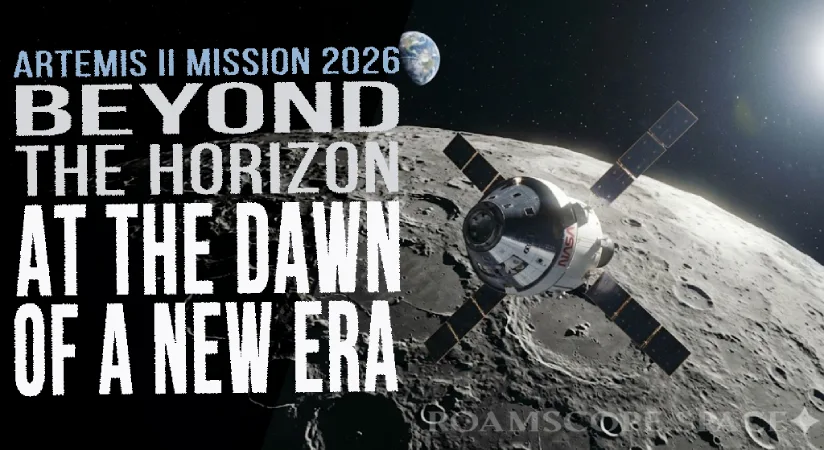
The Earth-Mars Vector Through a Lunar Prism.
World history is often written in silence, interrupted only by the dry reports of telemetry. While borders are being redrawn on Earthly maps, an event is unfolding four hundred thousand kilometers away—a milestone whose true scale will only become apparent decades from now. The Artemis II mission officially marks the end of “Earthly seclusion,” transforming humanity from inhabitants of a single planet into a future multiplanetary civilization.
What was the core purpose of this mission? It is essential to understand the division of roles: the Orion spacecraft is a NASA creation, specifically engineered for deep space. This flight served as the first critical test of its life support systems with a human crew on board. Unlike automated probes, the crew manually tested maneuvering, communication arrays, and life-support stability under harsh deep-space radiation. It was a trial of endurance for both “hardware” and humans before the next, decisive step.
Who are the heroes of this historic moment? For the first time in 54 years, humans have journeyed to the Moon, and their names are already etched in history. The mission commander is Reid Wiseman, a veteran NASA astronaut. Beside him are pilot Victor Glover, mission specialist Christina Koch (the first woman to journey to the Moon), and Canadian Jeremy Hansen. The entire world watched as this international crew surpassed the 406,700-kilometer mark from Earth, setting a new absolute distance record for a crewed spacecraft.
How is Elon Musk involved with Orion? Here lies the most fascinating detail of the modern space race. While Orion itself was built by NASA, the entire Artemis program is inconceivable without SpaceX. Musk’s team developed the Starship HLS—a lunar version of their super-heavy spacecraft, which in future missions will dock with Orion in orbit to ferry humans to the surface. SpaceX’s contribution is not just machinery, but strategy: thanks to their success in rocket reusability, the program’s costs have become sustainable, and the pace of preparation has accelerated significantly.
What is the global media saying, and what did the crew see? Headlines from major outlets are dominated by images of the far side of the Moon, which the astronauts broadcasted in real-time. One of the most discussed moments was the “Earth Occultation.” When the massive lunar disk completely obscured the home planet, leaving only a glowing ring of atmosphere, it caused a sensation on social media. Journalists are calling it “humanity’s most important selfie,” a stark reminder of our fragility in the infinite void.
From a technical standpoint, this flight is a dress rehearsal for the leap to Mars. Official reports confirm the successful testing of laser communications, transmitting data at the speed of light, and new shielding systems against solar flares. These technologies will become the bedrock for Martian expeditions, where autonomy will be a matter of survival.
We conclude this stage with a clear understanding: the Moon is not the final destination, but a proving ground. It is “kilometer zero” on the long road to the red sands of Mars. Exploratory passion, backed by the power of modern computing and the audacity of innovators, is turning science fiction into the chronicle of tomorrow. We are witnesses to humanity finally outgrowing its cradle.
If you enjoyed this material, please share the link to this article on your social media. You may also support the author with a donation for their development.




 Support our blog! Buy us a coffee, and we'll show you the world! ☕🌍 We need your help! Even a small amount will help us continue to delight you with interesting travel articles. Thank you for your support! 💖