
3I/ATLAS: The Strategy of the Cosmic Bluff
? ANALYTICAL REVIEW
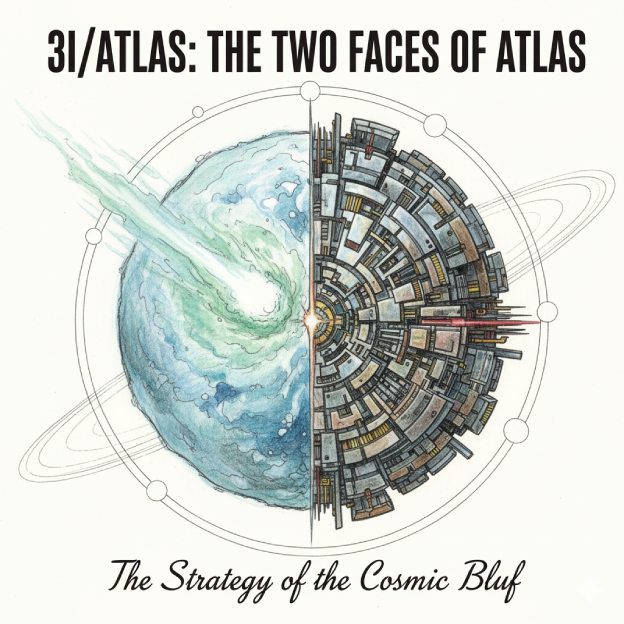
Independent analysis of 3I/ATLAS as a technological probe. We view NASA’s caution as a “Cosmic Bluff”—a masking strategy against a superior intelligence.
?️ Introduction. Disclaimer and Methodology
The interstellar object 3I/ATLAS (C/2019 Q4) has challenged official science by displaying an unprecedented combination of seven anomalous characteristics that cannot be simply explained by a comet. This article presents an independent analysis that questions the completeness of public data and interprets the scientific community’s caution as a “Cosmic Bluff”—an active strategy aimed at masking our capabilities in the face of a technologically superior guest. We explore the logic of this concealment using a military-strategic approach.
This material is a subjective analytical review performed by a group of private individuals and does not claim to be objective truth. We use theses disputed by the majority of scientists (e.g., the hypothesis of 3I/ATLAS’s technological origin) solely as hypothetical starting bases for constructing our counterarguments. Our goal is to raise new, non-standard questions and stimulate discussion.
? Explanation of Methodology
This report employs the Wave Method of Reasoning—a logical technique where each new conclusion (“wave”) is built not on the initial data, but on the completed conclusion of the previous wave. This allows us to move from obvious hypotheses to deep, non-trivial conclusions (a deduction from a deduction). The First Wave (comparing official data with facts) was worked out during the preparation stage. We begin publication with the Second Wave, where we analyze the motives and consequences of the identified discrepancies, immediately elevating the analysis to a military-strategic level.
I. Seven Anomalies: Why 3I/ATLAS Does Not Resemble a Comet
The official position of the international scientific community (including NASA) is that 3I/ATLAS is a comet. However, as proponents of alternative hypotheses (including well-known astrophysicists) note, the object exhibits seven characteristics, the combination of which practically rules out a random, natural origin.
| No. | Anomaly | The Unusual Aspect (Position of Alternative Hypotheses) |
| 1 | Extremely Low Orbital Inclination |  ‘s orbit is almost precisely in the plane of our Solar System ( ‘s orbit is almost precisely in the plane of our Solar System ( to the ecliptic). This is highly improbable for a random interstellar object and appears to be purposeful, energy-efficient movement. to the ecliptic). This is highly improbable for a random interstellar object and appears to be purposeful, energy-efficient movement. |
| 2 | Lack of a Visible “Tail” | The object did not display a large, distinct cometary tail (gas and dust), which should be present with such strong non-gravitational acceleration. |
| 3 | Non-Gravitational Acceleration | The object accelerates faster than can be explained by the Sun’s gravity. This acceleration has no visible source, suggesting an artificial engine or the ejection of invisible matter (e.g., solid hydrogen). |
| 4 | Strange Chemical Composition | The object’s composition showed an unusually high Nickel-to-Iron ratio. This is uncharacteristic of natural bodies and, conversely, typical for industrial production and durable alloys. |
| 5 | Compact Shape and Speed | The object proved to be too dense and fast for an ordinary cometary structure. |
| 6 | Fine-Tuned Route | 3I/ATLAS’s trajectory looks like a “planetary tour,” passing close to the orbits of Mars and Jupiter, which is highly unlikely for a random visitor. |
| 7 | Connection to the WOW! Signal Direction | 3I/ATLAS’s arrival direction coincides with the area of the sky from which the famous “WOW! Signal”—the strongest candidate for an extraterrestrial radio signal—was received in 1977. This fact may hypothetically suggest the object is purposeful, having arrived in response to our early radio messages. |
II. Analysis of Caution Motives: Economics, Logic, and Technology (Second Wave)
The analysis focuses on the discrepancy between official statements and the potential capabilities of global reconnaissance systems.
1. Observation Capabilities and Questions About Data Completeness
- Official Thesis (OT): Official sources (NASA) state that the object is too small and distant, preventing detailed imaging.
- Official Position: The scientific community claims that detailed images of 3I/ATLAS’s surface are unavailable from Earth.
- Common Sense Counter-Argument (CS-CA): This thesis raises questions about the completeness of public data.
- Argument: Open-source data on civilian Earth remote sensing satellites shows resolution less than 30 centimeters per pixel. Strategic reconnaissance logic allows the presumption that classified surveillance systems possess manifoldly superior capabilities, and detailed data on 3I/ATLAS may have been obtained.
- Conclusion (Cognitive Fear): The claim of detail unavailability is strategically convenient. This allows the hypothetical suggestion that someone possesses the data but is withholding it, fearing a technological shock and inability to counteract what was seen.
2. Anomalies and Financial Interest
- OT (Basis): All anomalies are explained by natural processes, and criticism of technological hypotheses is a rigorous scientific process.
- CS-CA (Counter-Argument): Acceptance of the natural origin hypothesis supports the existing scientific model.
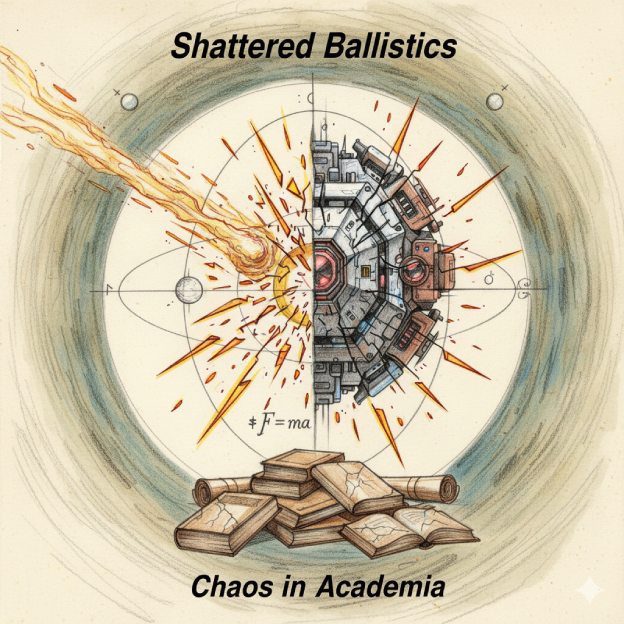
- Explanation: The existence of 3I/ATLAS with its seven anomalies (see Section I)—especially non-gravitational acceleration without visible emission and an anomalously low orbital inclination—casts doubt on the fundamental laws of physics and Newtonian ballistics.
- Conclusion (Economic Fear): If the object violates known laws, this collapses the scientific foundation of many existing theories, formulas, and calculations, leading to chaos in the academic world. The sharpness of criticism directed at technological hypotheses may be caused not only by scientific skepticism but also by the fear of collapse of current fundamental scientific programs, requiring a complete overhaul of methodology and, consequently, funding. Preserving the image of a “Comet” temporarily ensures stability and prevents panic in the scientific community.
III. The Strategy of the Cosmic Bluff and Risk Assessment (Third Wave)
This section develops the theme of information concealment as an active strategic measure (focus on security).
- Probe or Ship? From a strategic reconnaissance perspective, 3I/ATLAS is more logically considered an autonomous, advanced carrier probe (or “mothership”) rather than a large reconnaissance mega-ship. A carrier probe is smaller, less noticeable, and, critically, capable of deploying a reconnaissance network.
- Hypothesis of Probe Separation (Per Loeb): The hypothesis by renowned astrophysicist A. Loeb that the object may have released autonomous, smaller probes (mini-bases) seems logical. A small, passive object (meters in size or smaller) is virtually impossible to detect with Earth-based means.
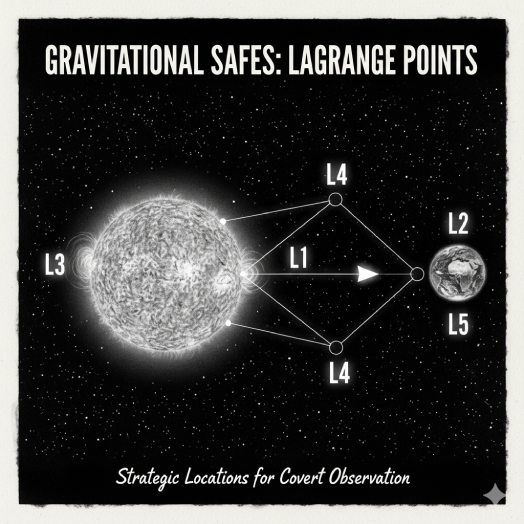
- Lagrange Points as Bases: These small objects may be placed in gravitationally stable Lagrange Points (
 ,
,  ), where they can remain in Earth-relative calm long-term, serving as covert observation or reconnaissance mini-bases.
 - Argument for Proximity of Intelligence: If 3I/ATLAS is a carrier probe, and its operators can be located close enough for rapid feedback (minutes or hours), this rules out control from outside our galaxy.
- Conclusion (Cosmic Bluff): The cautious and incomplete statements from official structures can be interpreted as a strategic disguise. Governments may be intentionally downplaying their reconnaissance capabilities to give the probe’s operators the impression of our technological primitiveness. This is an active bluff aimed at avoiding direct confrontation and making the aliens deem Earth uninteresting for further study.
IV. Geometry of the Threat: Hypothetical Positioning (Fourth Wave)
We conduct a non-standard calculation based on the laws of physics to determine the maximum possible distance of the command center, based on operational communication requirements.
- Calculation Methodology: An author’s hypothetical model is used, based on the fundamental principle of physics:
 (the dependence of distance on signal travel time at the speed of light).
 - Hypothetical Postulate: The operational communication cycle (
 ) must be no more than 24 hours (
 ) for effective command.
Postscript on the Communication Scheme: The Earth  Base Probe scheme is chosen because it reflects the most prolonged and critical phase of operational command: the Base’s reception of information about Earth’s reaction and the subsequent sending of a corrective command to the Probe. We use this full command-and-control cycle to determine the maximum geometry of the threat.
Option 1: Maximum Possible Distance (Oort Cloud)
Calculation of
![\[ D_{max}: \]](https://roamscope.space/wp-content/ql-cache/quicklatex.com-0e7049ec7c2563e533af1516a8ffd3d1_l3.png "Rendered by QuickLaTeX.com")
![\[ D_{max} = \frac{\text{Reaction Time} \times \text{Speed of Light}}{2} \approx 12.96 \text{ billion km} \]](https://roamscope.space/wp-content/ql-cache/quicklatex.com-973df1dcc907641f1ec27ccd5b73b700_l3.png "Rendered by QuickLaTeX.com")
![\[ D_{max} \approx 86.6 \text{ AU} \]](https://roamscope.space/wp-content/ql-cache/quicklatex.com-9ea8bcdd5d6666ccf35c54af9cb481e8_l3.png "Rendered by QuickLaTeX.com")
Analytical Conclusion: The distance of  places the potential base at the inner boundary of the Oort Cloud. This logically confirms that the extraterrestrial intelligence is capable of masking itself at immense distances while maintaining operational control over objects in the Solar System.
Option 2: Closest Hidden Distance (Kuiper Belt)
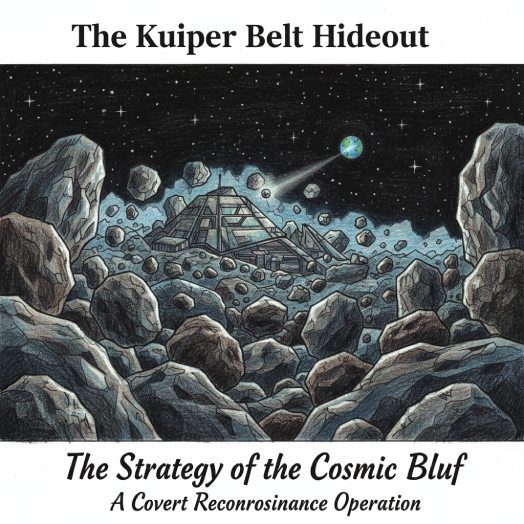
Hypothesis: For even faster communication (e.g., 8 hours) or simpler logistics, the base could be much closer, for example, in the Kuiper Belt ( ).
).
Analytical Conclusion: Location in the Kuiper Belt or even Neptune’s orbit ( ) remains completely invisible to Earth-based telescopes (short of a targeted search), but reduces communication time to Earth to just a few hours. This makes the threat more immediate and logically explains why Earth’s military structures might have panicked.
General Conclusion on Geometry: The range of potential locations for the extraterrestrial command center varies from the Kuiper Belt to the Oort Cloud. This indicates that the object is part of a deeply echeloned and covert reconnaissance operation operating at the boundaries of our Solar System.
? Conclusion
- Main Conclusion: The analysis of 3I/ATLAS’s anomalies and the incompleteness of public data allows the hypothetical suggestion that the object is a technological carrier probe. The caution in the statements of official structures can be interpreted, from our point of view, as a strategic defense measure—the “Cosmic Bluff.”
- Questions for Discussion: Our analysis opens up a number of questions requiring attention, which we formulate for further, deeper discussion:
- What is the real resolving power of classified space surveillance assets?
- Do current ballistics and motion models, actively funded by scientific foundations, allow for the existence of 3I/ATLAS without violating the principles of energy conservation?
- How high is the probability of covert placement of observation probes in the strategically important Lagrange Points?
- What are the minimum requirements for communication speed and object power consumption to ensure operational command of a probe at a distance of
 ?
? - Given the potential danger of 3I/ATLAS, should the international scientific community immediately cease all active signal transmission projects into space (METI) and reconsider the ethics of contact?
Caveat: All hypothetical constructions and calculations presented in this review are purely analytical and are not intended to discredit anyone. The goal of the article is to raise new, non-standard questions and stimulate discussion in interested communities.
If you found this analysis compelling, please share the link to this article in your communities.
You can also support the idea’s author [Dima] with a donation.




 Support our blog! Buy us a coffee, and we'll show you the world! ☕🌍 We need your help! Even a small amount will help us continue to delight you with interesting travel articles. Thank you for your support! 💖