
3D Printing Business 2026: Equipment, Software, and Professional ROI Guide
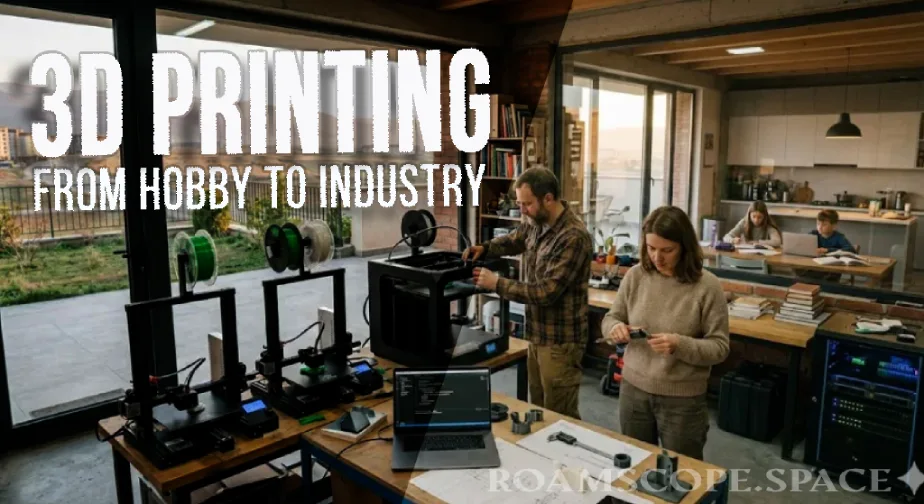
Professional 3D Printing 2026: Equipment, Technologies, and Business Scenarios.
By 2026, 3D printing has finally transitioned from the “hobbyist toy” category into the realm of real industrial production. For those considering additive manufacturing as the foundation for a business, it is critical to understand one thing: there is no universal solution. Every task — from a simple remote control casing to a jet engine component — requires its own specific technology stack.
1. The Software Ecosystem: A Professional’s Toolkit
Your choice of software determines whether you can design a part capable of withstanding real-world physical loads.
Engineering Design (CAD)
- Fusion 360 (Autodesk): The standard for small and medium businesses. Its main advantage in 2026 is the generative design and Finite Element Analysis (FEA) modules. You can define attachment points and force vectors, and the AI will suggest the optimal organic shape for the part.
- FreeCAD: The only comprehensive free solution for those building a business on Open Source principles. It allows for the creation of complex mechanisms but requires time to master its data architecture and “workbenches.”
- Onshape: A cloud-based CAD system from the creators of SolidWorks. It allows an entire team of engineers to collaborate on a single project simultaneously, which is critical for complex drone or robotic assemblies.
Power Plant and Micromechanics Design
When the task involves designing engines (electric or internal combustion), specialized tools are used:
- nTopology: This software is used to create complex internal structures (lattices/gyroids) that are impossible to draw manually. This allows for the creation of cooling radiators or engine parts with maximum heat dissipation surface area.
- Ansys Discovery: A program for instantaneous fluid and gas flow analysis. Indispensable for designing turbines and air intake ducts.
2. Hardware: From Polymers to Metals
Mid-Range and High-End Segment (FDM/FFF)
For most business tasks, printers that extrude molten filament are used.
- Mid-Level (Workstations):
- Bambu Lab P2S: The leader in the “price-to-speed” ratio. The enclosed chamber allows for stable work with ABS and PETG.
- Prusa CORE One: A newcomer with an active thermal chamber. Ideal for technical parts where dimensional repeatability is vital.
- Qidi Tech X-Max 3: Boasts a massive build volume and a nozzle that reaches 350°C.
- High-End (Engineering Complexes):
- Bambu Lab X1E: An industrial version with advanced filtration and enhanced data security.
- Prusa XL (5 Heads): The only printer in its class that allows for printing complex parts using multiple different materials simultaneously.
- Raise3D Pro3: A heavy-duty industrial solution designed for 24/7 operation.
Metal Printing (SLM/DMLS)
To create functional engines (e.g., combustion chambers or turbine housings), printers that fuse metal powder with a laser are used.
- Technology: SLM (Selective Laser Melting) allows for the creation of parts from titanium, inconel, or aluminum.
- Equipment: This is a segment with costs starting from $150,000. Models like the EOS M100 or Desktop Metal Shop System are industry leaders. Within a small business framework, this type of printing is usually outsourced to large hubs, while you prepare the CAD files.
3. Applied Business Scenarios
Below is a detailed breakdown of three directions with specific tools indicated.
Scenario A: Drones and Aviation Modeling
The Task: Creating frames, protective shrouds, and payload release systems.
- Printers: Only enclosed systems with bed temperatures of 110°C+. Ideally, the Bambu Lab H2D (for printing complex aerodynamics with dissolvable supports).
- Materials: PA12-CF (Carbon Fiber Reinforced Nylon). This is the “king” of 3D aviation: lightweight, vibration-dampening, and highly impact-resistant. TPU (Flex) is used for camera gimbal dampers.
- Nuance: All parts are designed in Fusion 360 with calculated centers of mass.
Scenario B: Technical Auto Tuning and Appliance Repair
The Task: Printing intake ducts, headlight brackets, bumpers, and gears.
- Printers: Requires a large build volume. The Anycubic Kobra 3 Max (for large panels) and Qidi Q2 (for high-temp engine parts) are suitable.
- Engine Work: Cooling system pipes and intakes are printed from Polycarbonate (PC) or ASA. These materials withstand heat up to 100-140°C without losing shape.
- Bumpers: Printed in sections using ASA, then joined via chemical welding. ASA is resistant to road reagents, oil, and UV rays.
- Tools: A digital caliper is mandatory, along with a set of taps for threading plastic parts.
Scenario C: Custom Electronics Enclosures and Small Batches
The Task: Rapid production of smart home housings, remotes, and server mounts.
- Printers: Printers with automatic material switching, such as the Bambu Lab P2S with AMS. This allows for embedding button markings and logos directly into the housing without using paint.
- Materials: PETG (universal, chemically resistant) or ABS (if a perfect smooth finish via an acetone bath is required).
- Software: Blender for external shape design + Fusion 360 for precise positioning of internal USB/HDMI connectors.
4. Financial Plan: Startup Budget (April 2026)
Estimated budget for organizing a professional hub (3 printers + accessories).
| Expense Item | Lari (₾) | Dollars ($) | Euros (€) | Rubles (₽) |
| Equipment (e.g., 2x P2S + 1x XL) | 6,800 ₾ | $2,580 | €2,370 | 237,000 ₽ |
| Engineering Filament (20 kg) | 1,500 ₾ | $570 | €520 | 52,000 ₽ |
| Dryers and Storage Systems | 600 ₾ | $230 | €210 | 21,000 ₽ |
| Measuring and Hand Tools | 400 ₾ | $150 | €140 | 14,000 ₽ |
| Safety (Ventilation/Fire) | 500 ₾ | $190 | €175 | 17,500 ₽ |
| TOTAL: | 9,800 ₾ | $3,720 | €3,415 | 341,500 ₽ |
5. What You Need to Know Before Starting
- Thermal Regulation: When printing auto parts or drone components from engineering plastics, the slightest draft in the room will lead to delamination (layer splitting). The printer must be in a stable temperature environment.
- Post-Processing: The professional look of a part is 50% printing and 50% processing. You will need sandblasting chambers, chemical baths, or specialized plastic primers.
- Hazardous Emissions: Printing with ABS, Nylon, and Polycarbonate releases styrene and other gases. A filtration system is not a recommendation; it is a survival requirement in this business.
- Speed and ROI: Do not expect fast printing for large objects. A part the size of a bumper can take 48–72 hours to print. Plan your schedule so that the printers work through the night.
This overview provides an understanding that 3D printing in 2026 is a full-fledged digital manufacturing process requiring deep knowledge of material science and engineering software. A successful start begins not with the purchase of a printer, but with the choice of a specific niche and the materials in which you will become an expert.
Support the Author
If this article was useful to you or gave you food for thought, you can support the development of my projects. Share the link to this text on your social networks—it will help the blog grow. And if you have a desire to support the author financially, you can send a voluntary donation for the development of the blog. Every bit of support gives me more time and energy to create new, deep materials. Thank you for being with me!



 Support our blog! Buy us a coffee, and we'll show you the world! ☕🌍 We need your help! Even a small amount will help us continue to delight you with interesting travel articles. Thank you for your support! 💖