
⚡ Electromagnetism 101: Unlocking the Power of Magnetic Fields and Electricity Generation
Hey there, future engineers, drone pilots, and robotics enthusiasts!
Like many of you, I’m currently diving headfirst into a demanding course—one that requires a solid grasp of physics, specifically the fascinating world of electromagnetism. Everything you read here is the result of my own deep dive into online resources and technical literature. I’m sharing this knowledge not as an expert, but as a dedicated self-learner, trying to distill complex concepts into clear, actionable understanding. I’m doing the hard work to figure this stuff out so we can all build better drones and robots!
Let’s tackle the fundamentals: what exactly is a magnetic field, where does it come from, and how does it magically give us the power of electricity?
? What is Magnetism and the Magnetic Field?
Magnetism is one of the universe’s fundamental forces, directly linked to electricity. Together, they form the single force we call Electromagnetism.
The Magnetic Field is an invisible area of force that surrounds any moving electric charge. Think of it as the “force field” created by magnets and electrical currents.
? Key Properties of the Magnetic Field
Understanding these characteristics is the first step to harnessing this power:
- The Invisible Pathway (Field Lines): We can’t see the field, but we represent it using magnetic field lines. These lines show the direction and strength of the force.
- Always a Loop: Field lines always exit the North Pole (N) of a magnet and enter the South Pole (S), forming closed, continuous loops. They never begin or end.
- Interaction with Charge: This is crucial: A magnetic field only exerts a force on electric charges that are in motion. This principle is what makes motors and generators work!
? Field Sources: More Than Just Fridge Magnets
When I first started, I assumed magnetic fields only came from permanent magnets. The core lesson I learned from my online research is that magnetic fields have two main sources, and one is far more important for modern technology.
1. Permanent Magnets
In materials like iron or nickel (ferromagnetics), the magnetic field originates from the motion of electrons within the atoms. Specifically, the spin of these electrons acts like a tiny, individual current loop. In a permanent magnet, the spins of billions of these electrons are aligned in the same direction, causing their tiny fields to add up and create one strong, stable field.
2. Electric Current (Electromagnetism)
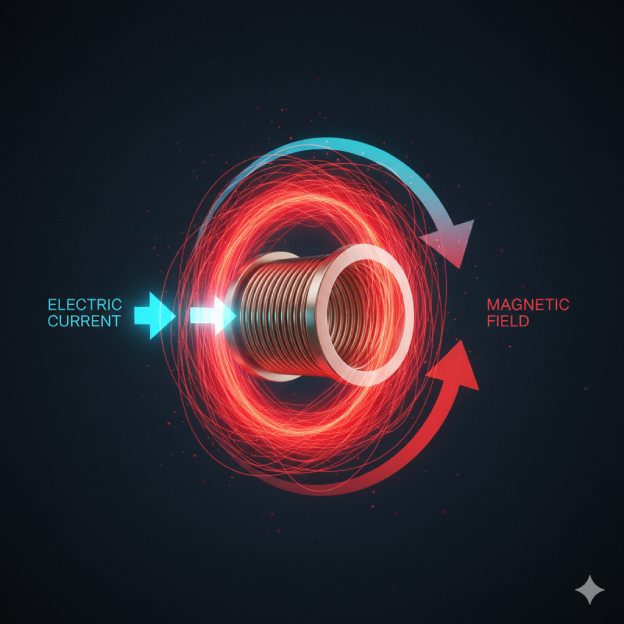
This is the big one. Any electric current—that is, any flow of electric charges—creates a magnetic field around its path.
- Example: The Solenoid: If you run current through a straight wire, you get a weak field. But if you coil that wire tightly (creating a solenoid or electromagnet), the fields from each loop combine and amplify significantly inside the coil.
- The Advantage: Electromagnets allow us to switch the field on and off instantly and control its strength precisely by adjusting the current. This flexibility is what powers everything from doorbells to industrial cranes.
In summary, magnetic fields arise from:
- Intrinsic electron motion (Permanent Magnets).
- Bulk flow of electric charges (Current) (Electromagnets).
- The Earth’s core (Convection currents of molten iron, essentially a massive natural current).
? Amplification: How to Strengthen a Magnetic Field
For any serious engineering application, we need strong, controlled fields. Based on my learning, we can boost field strength in several practical ways:
- Increase the Current (Electromagnets): The most direct method. Double the current, double the field strength (to a certain point). This is a linear, reliable control mechanism.
- Increase the Number of Coils (Electromagnets): More loops mean more individual magnetic sources adding together. Generators and motors use thousands of tightly packed turns.
- Introduce a Ferromagnetic Core: Place a piece of highly magnetic material (like soft iron) inside the coil. This material becomes intensely magnetized itself, acting as a powerful amplifier for the coil’s original field. This creates the most powerful electromagnets.
- Reduce Distance: Magnetic force drops off rapidly with distance. Keeping the working gap between poles as small as possible maximizes the force.
? The Magic of Generation: How Magnetic Fields Create Electricity
This is the principle that fuels the modern world: Electromagnetic Induction, discovered by Michael Faraday. It’s the elegant, two-way street between electricity and magnetism.
Crucial Takeaway: Electricity is only generated when there is RELATIVE MOTION between the magnetic field and the conductor.
A Simple Analogy: Imagine a magnetic field as a lake and your electrical wire as a boat. You won’t catch any fish (electric current) if the boat is sitting still in the lake. You must move the boat through the water (the wire through the field lines) or have the water move quickly past the boat (a changing magnetic field passing the wire).
The Law in Action (Faraday’s Law)
Any change in the magnetic environment of a coil of wire will cause a voltage (and thus a current) to be “induced” in the coil.
- Example 1: The Generator: We use mechanical power (wind, steam, water) to rotate a coil inside powerful magnets. This rotation constantly forces the wire to cut across the magnetic field lines, which induces a continuous flow of electric current.
- Example 2: The Transformer: This device has no moving parts! It uses an Alternating Current (AC) in the first coil. Since AC constantly changes direction, it creates a constantly changing magnetic field. This changing field then induces a new current (often at a different voltage) in a second, nearby coil. No physical motion is required, only change in the field strength.
In short, motion or change is the catalyst that turns magnetism into usable electric power.
?️ Real-World Impact: From Motors to Spacecraft
The principles of electromagnetism underpin virtually every piece of technology we rely on today. For those of us studying robotics, these applications are our future career path.
| Application Area | How Magnetism is Used |
| Robotics & Drones | Motors & Actuators: Electric motors convert the force of magnetic fields (generated by current) back into rotational motion. |
| Renewable Energy | Wind Turbines: Massive generators use induction to convert the mechanical rotation of blades into electric power. |
| High-Speed Transit | Maglev Trains: Use powerful superconducting electromagnets for levitation (magnetic repulsion) and propulsion (controlled magnetic pull/push), eliminating friction. |
| Computing | Data Storage: Hard disk drives (HDDs) read and write data by using a tiny magnetic head to alter the magnetic orientation of domains on a disk. |
? The Future: Aerospace Applications and Frontiers
This is where the principles we’ve learned get truly revolutionary:
- Magnetic Shields for Deep Space: The Earth’s magnetic field protects us from harmful solar radiation. For astronauts traveling to Mars or beyond, scientists are developing powerful, compact, and often superconducting magnetic coils to generate an artificial mini-magnetosphere around the spacecraft, actively deflecting high-energy cosmic rays.
- Contactless Technology in Aircraft: Magnetic levitation can be used to create frictionless bearings in jet engines or high-speed rotating components. This reduces wear, eliminates the need for lubrication in extreme environments, and increases efficiency.
- Electromagnetic Launchers (Railguns): Instead of using chemical rockets, powerful electromagnets could be used to accelerate payloads (or even future aircraft) up a track to extremely high speeds, potentially making launches into orbit cheaper and more efficient. This is the ultimate application of the Lorentz force!
? Final Thoughts for Fellow Learners
My journey into the online information regarding magnetism has made one thing perfectly clear: The relationship between current and magnetic fields is a dynamic loop.
- Current $\rightarrow$ Creates a Magnetic Field (Electromagnetism)
- Motion/Change in Field $\rightarrow$ Creates Current (Induction)
Grasping this fundamental interplay is not just academic; it’s the essential key to designing, programming, and troubleshooting any system that involves motion and electricity—the very core of drone and robot technology. Keep learning and keep building!
Did this article help simplify these powerful concepts? I’m working hard to put this complex material into accessible language.
- ? If you found this useful, please share the link with your fellow students and professional networks on platforms like LinkedIn, Reddit, or Twitter. Let’s make this knowledge available to everyone!
- ? As I continue my studies in robotics and engineering, any support is greatly appreciated! Feel free to send a donation to encourage more in-depth, self-taught content like this.



 Support our blog! Buy us a coffee, and we'll show you the world! ☕🌍 We need your help! Even a small amount will help us continue to delight you with interesting travel articles. Thank you for your support! 💖